On a humid Thursday morning, the Ramathibodi Poison Center in Bangkok thrums with activity. Four staff members field roughly 130 emergency hotline calls every day. By 11 a.m., they have already answered 42. Some callers are worried they’ve consumed something toxic. Others are medical students seeking advice on treating overdose patients. But every day, several physicians call from across Thailand looking for advice on treating snakebite victims.
The nurses, pharmacists, and paramedics fielding the calls answer several questions: Is the snake in question venomous? Should they intubate the patient or simply dress the wound? Will it require an antivenom, and if so, where can they find it?
The center, which is one of two in Thailand, typically receives about a thousand snakebite-related calls a year. But over the past four years, that number has risen to about 1,500. More than half of them are about venomous species such as the king cobra, the Malayan krait, and the pit viper. Calls to the 24-hour hotline peak during the rainy season when floods force snakes from their habitats and into closer contact with humans.
“We have been established for 30 years, since 1996, and we have never closed our poison center,” said Dr. Satariya Trakulsrichai, a toxicologist, internist, and head of the poison center. Patients bitten by a venomous snake can suffer debilitating and long-lasting health consequences, including chronic nerve pain, kidney disease, and necrosis. The center runs an outpatient clinic for such patients every Friday.
Every year, millions of people are bitten by snakes. The most recent global count by the World Health Organization, or WHO, found that as many as 5.4 million people are bitten annually. Half develop envenoming — the medical condition that occurs when snake venom enters the body and triggers a toxic reaction. Approximately 500,000 are left with permanent disabilities, and 138,000 people die. Asia is the epicenter of snakebites, where up to 2 million people are envenomed each year. And even those figures are likely an underestimate because snakebites are vastly underreported. Many victims, often in rural and lower-income areas, never reach health facilities.
Tony Karumba / AFP via Getty Images
Snakebites are less common in the United States. The Centers for Disease Control and Prevention estimates that roughly 7,000 people are bitten by snakes each year. Of them, five die. But as the planet warms, the monsoon season becomes more erratic, and humans increasingly encroach into snake habitats, snakebites seem poised to rise. Research at Emory University found that the likelihood of being bitten increases with every degree Celsius rise in daily temperatures. Snakebites are also more common during extreme weather events.
During droughts, for example, snakes may seek out water storage containers or cool, damp spots if their natural water sources have dried up, said Chloe Vasquez, executive director of the Global Snakebite Initiative USA Foundation, which works to reduce snakebite death and disability through community engagement programs and trainings for health workers. Droughts also force people to travel farther to collect water, increasing the likelihood of encountering snakes. And during storms or floods, snakes that typically hide underground are forced out. In cities, they might seek shelter in shops, homes, or sewage systems. Extreme climate events are also destroying agricultural livelihoods, pushing more rural workers to look for employment in cities. That urban expansion eats into snake habitats, driving the reptiles to nest in homes and gardens — putting them in closer contact with humans.
A dearth of data makes it difficult to measure exactly how extreme weather events are affecting snakebite numbers, but as climate change alters “where, when, and how snakes share space with people,” it will only exacerbate the issue, a spokesperson for WHO said. The agency is spearheading the global effort to reduce the number of snakebites by 50 percent by 2030. It has issued guidance to help countries develop national action plans, improve access to quality antivenoms, and share data and insights through a dedicated platform.
The work is especially critical because several snake species are now being seen in locations where they previously weren’t, said Vasquez. The brown spotted pit viper, for instance, was historically only found in China, Taiwan, and India, but is now being seen in Thailand. The four main venomous biters in India — the Indian cobra, common Krait, Russell’s viper, and saw-scaled viper — are increasingly being spotted in much wider swaths of the country, including northern India and the Western Ghats. New hotspots are also emerging in Niger, Namibia, Nepal, and Myanmar, according to research in The Lancet. Vasquez said that it’s likely snakes are moving to higher elevations to escape warmer temperatures.

The United States is no exception. In Arizona, unusually warm temperatures are rousing rattlesnakes from dormancy as early as March. That means snakes are increasingly being found on popular hiking trails. Local hotlines across the state have been reporting an increase in the number of bite-related calls for 2026 compared to the same time last year. In North Carolina, home to six snake species, a warmer April last year resulted in a higher number of snakebites than usual, and researchers found that in Georgia, hospital visits for snakebites are increasing as temperatures rise.
At the Queen Saovabha Memorial Institute snake farm in Bangkok, just a few miles away from the poison center, snake wranglers host a daily snake-handling demo for the public, draping Burmese pythons around the shoulders of tourists and staring down sunbeam snakes as their scales glisten in the afternoon rays. They tell the eager audience, camera phones in hand, which species are venomous and which ones are not, where you might find certain species, and why they need to be protected. They hope that increased education will promote snake conservation and decrease snakebites. Entrance fees to the snake farm also generate financial support for the institute’s ongoing work as a medical research center that produces antivenoms.

Matt Hunt / Anadolu Agency via Getty Images
The organization is a critical part of a national antidote program that was launched in 2011 with five other entities — including the Ramathibodi Poison Center — to ensure that snakebite victims across the country have access to the treatments they need. The institute has produced seven antivenoms so far and has been recognized by the WHO for “its crucial role in Thailand’s ongoing battle against snakebite envenomation.”
When the Ramathibodi Poison Center receives a photo of a snake that has bitten someone, staff members send it to Taksa Vasaruchapong, a veterinarian and head of the Queen Saovabha Memorial Institute. Not all snakebites require an antivenom, but many do, and to determine the correct course of treatment, hotline staff verify the species with Vasaruchapong. He receives up to five photos a day from the poison center and is also contacted by the Bangkok fire department, which is called out to retrieve a snake every 15 minutes. Depending on whether the snake is venomous, it is either relocated somewhere safe or brought to the institute’s snake farm, which uses the reptiles for research and to create a steady supply of antivenom.
Over the course of his career, Vasaruchapong has been bitten three times. During his first year at the institute 21 years ago, a monocled cobra dug into his right arm. He received antivenom immediately, which saved his life, but the fast-acting toxins had already done some damage. The incident left him with reduced functionality in one of his fingers and a scar that spans his forearm. He’s since been bitten two other times, but the risk doesn’t deter him from his mission to better understand a species he believes is among the world’s most neglected.
“Most people are afraid of them and kill them first, even if it is nonvenomous,” he told Grist.
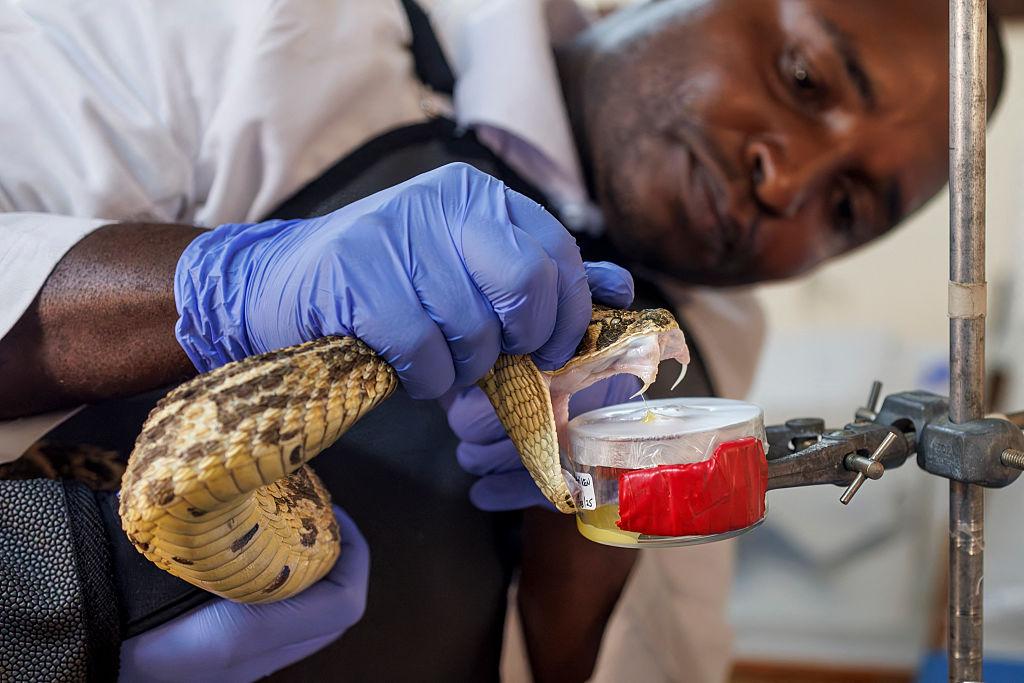
Antivenoms are developed by extracting venom from specific snake species and injecting small amounts into animals, such as horses, that can create large amounts of antibodies. These antibodies are then harvested from the animals’ blood, purified, and used to create antivenoms that neutralize the venom when injected into humans.
Antivenoms are costly and complex to make, and few countries invest in them. Lower-income countries are typically the most exposed but don’t have sufficient domestic antivenom stocks, and importing them can be expensive. There are “critically short supplies in many of the worst-affected regions,” said the WHO spokesperson. Even in regions with sufficient stocks, the antivenom has to match the specific geographical variation of venomous species that it was created for. As a result, antivenom created for a cobra found in Thailand may not be effective in treating a bite by one in Tanzania.
“Every region will have maybe one or a few products, and some regions have no products that are effective for their region, which is very disappointing,” said Vasquez.

Carola Frentzen / picture alliance via Getty Images
Compared to its neighbors, Thailand is ahead of the game. Tall fridges stacked with colorful antivenoms created by the institute sit at the entrance of the Ramathibodi Poison Center’s hotline room. The supply can combat the effects of the most common venomous species in the country. Funded by the Thai Red Cross, the snake farm’s work has made Thailand the only country in Southeast Asia with WHO-approved antivenoms that have undergone rigorous testing and laboratory analysis to ensure quality and efficacy. These antivenoms are stocked in all of Thailand’s major hospitals and are also distributed to neighboring countries. Aside from supplying them to clinics across the country at a subsidized price, the poison center also sells them to other countries with the same species, Vasaruchapong said.
But few countries have matched Thailand’s investment in antivenoms in part because underreporting of snakebites has led health ministries and pharmaceutical companies, among others, to believe the need for antivenoms is smaller than it actually is. The most common method of antivenom production requires a steady stream of venom that is milked from live snakes, funding to prop up a serpentarium, and specialists to harvest antibodies and immunize animals.
But there are only 46 such manufacturers globally, and pharmaceutical companies sometimes curtail antivenom production when it isn’t profitable.
In 2015, for example, Sanofi Pasteur, the French vaccine manufacturer, ceased production of its polyvalent African snake antivenom, Fav-Afrique, because the product wasn’t generating enough revenue.
When antivenoms do make it to a country, they can be expensive or stored miles away from the patients who need them most. “If you go out into the rural areas, people can die right in front of the hospital because there’s no antivenom there,” said Vasquez. “There are stock-outs, or maybe the hospital doesn’t even stock antivenom most days, and so then they have to travel to the next hospital and the next.”
Climate change is only going to exacerbate the global shortage of antivenoms, she said. The WHO has been calling for countries to “future-proof” their snakebite responses and anticipate crises. That includes bolstering antivenom stockpiles, creating conservation areas for snakes, training health care workers on treatment, and educating people on how to avoid getting bitten.
Both Vasaruchapong and Trakulsrichai said there hasn’t been enough research to know the extent to which a warming planet will drive up their workload in Bangkok. If snakebites do become more prevalent, Thailand has a stable production line of antivenoms for the most common snakes strategically stored across the country. The same can’t be said elsewhere.