Nucleases
Previously reported4,9,15,25,73 and newly designed gRNA spacers are listed in Supplementary Table 1. RNP complexes were assembled by incubating at 1:1.5 (IL2RG and AAVS1) or 1:2 (CD40LG and B2M) molar ratio with SpCas9 protein (Aldevron) with either preannealed synthetic Alt-R crRNA:tracrRNA or sgRNA (Synthego) for 10 min at 25 °C. The H1 clone was generated using zinc finger nucleases targeting AAVS1 (ref. 13).
Plasmids and vectors
AAV transfer vector constructs for IL2RG, CD40L, AAVS1 and RAG1 editing are described in Figs. 1–3, Extended Data Fig. 5a and Supplementary Fig. 1. All cargo cassettes are flanked by AAV serotype 2 inverted terminal repeats (ITRs)74.
For screening purposes, full-length gRNAs and tgRNAs targeting AAVS1 and CXCR4, to be coupled with dCas9–TAD or Cas9–TAD were cloned in a pUC.U6 plasmid with BsaI (New England Biolabs (NEB)). gRNA spacers are listed in Supplementary Table 1. The Sp.dCas9-VPR plasmid was bought from Addgene (63789). The Sp.dCas9-VP160 plasmid was cloned by swapping VPR with VP160 DNA sequence. Cas9–VPR was derived from the former by restoring the Cas9 sequence. TALE DBDs were cloned by Golden Gate strategy (Addgene) in a pUC plasmid and fused in frame at the C terminus with either VP160–TAD or VPR–TAD. ArT sequences are listed in Supplementary Table 2. Vector maps were designed with SnapGene (GSL Biotech, https://www.snapgene.com/).
mRNA in vitro transcription (IVT)
GSE56, GSE56/E4orf6/7, TALE–TA, dCas9–VPR and Cas9–VPR were subcloned in a pVax plasmid. Specifically, ArT and GSE56 constructs were cloned into optimized ‘pVax’ plasmids under the control of the following 5′ aptamer sequence: CapAG–eIF4G aptamer (GACTCACTATTTGTTTTCGCGCCCAGTTGCAAAAAGTGTCG)–Kozak sequence (CCACC)–start codon (ATG). Downstream, the codon-optimized sequence follows a woodchuck hepatitis virus post-transcriptional regulatory element and a 64-bp poly(A) sequence. Methods for mRNA IVT, quantification and quality assessment were previously described5,25,35. Briefly, pVax plasmids were linearized with SpeI (NEB) and purified by phenol–chloroform extraction. mRNA IVT was performed with THE 5× MEGAscript T7 kit (Thermo Fisher) and capped with 4.5 mM anti-reverse cap analog 3′-O-methyl-mG(5′) ppp(5′)G (New England Biolabs) mixed in a 1:5 ratio with dGTP nucleotides or 5 mM CleanCapAG (Trilink). mRNAs were then purified using an RNeasy Plus mini kit (Qiagen) followed by high-performance liquid chromatography (ADS BIOTEC WAVE System) and Amicon Ultra-15 (30 kDa) tube (Millipore) concentration. mRNAs were aliquoted and stored at −80 °C.
Cell lines and primary cell culture
K-562 cells and the H1 clone were cultured in Iscove’s modified Dulbecco’s medium (Corning) supplemented with 10% heat-inactivated FBS (Euroclone), 100 IU per ml penicillin, 100 μg ml−1 streptomycin and 2% glutamine.
For T cells, buffy coats were obtained as anonymized residues of blood donations, used upon signature of specific institutional informed consent for blood product donation by healthy blood donors in accordance with OSR protocols. CD4 T cells isolation was performed using the CD4+ T cell isolation kit (Miltenyi Biotec) and cultured in X-Vivo 15 (Lonza) supplemented with 0.5% HSA (Baxalta), 1% penicillin–streptomycin (Lonza), 100 IU per ml IL-7 and 200 IU per ml IL-15 (both from Miltenyi Biotec).
CB CD34+ HSPCs were purchased from Lonza according to the TIGET-HPCT protocol approved by OSR Ethical Committee. Cells were seeded at 5 × 10⁵ cells per ml in serum-free StemSpan medium (StemCell Technologies) supplemented with 100 IU per ml penicillin, 100 μg ml−1 streptomycin, 2% glutamine, 100 ng ml−1 hSCF (PeproTech), 100 ng ml−1 hFlt3-L (PeproTech), 20 ng ml−1 hTPO (PeproTech), 20 ng ml−1 hIL-6 (PeproTech), 10 μM PGE2 (at the beginning of the culture, Cayman), 1 μM SR1 (Biovision) and 50 nM UM171 (StemCell Technologies).
G-CSF or G-CSF + Plerixafor mPB CD34+ HSPCs were purified with the CliniMACS CD34 reagent system (Miltenyi Biotec) from Mobilized Leukopak (AllCells) according to the TIGET-HPCT protocol, following the manufacturer’s instructions. HSPCs were seeded at 5 × 10⁵ cells per ml in serum-free StemSpan medium (StemCell Technologies) supplemented with 100 IU per ml penicillin, 100 μg ml−1 streptomycin, 2% glutamine, 300 ng ml−1 hSCF (PeproTech), 300 ng ml−1 hFlt3-L (PeproTech), 100 ng ml−1 hTPO (PeproTech), 1 μM SR1 (Biovision) and 35 nM UM171 (StemCell Technologies) (referred to as ‘standard medium’). Alternatively, mPB HSPCs were seeded in GMP stem cell growth medium (CellGenix, with or without phenol red) supplemented with 100 IU per ml penicillin, 100 μg ml−1 streptomycin, 100 ng ml−1 hSCG, 100 ng ml−1 hFLT3, 50 ng ml−1 hIL-3, 50 ng ml−1 hIL-6, 50 ng ml−1 hTPO (all from Sartorius CellGenix), 1 μM SR1 and 35 nM UM171 (referred to as ‘optimized medium’).
All cells were cultured in a 5% CO2 humidified atmosphere at 37 °C.
Gene editing of human HSPCs, T cells and K-562 cell line
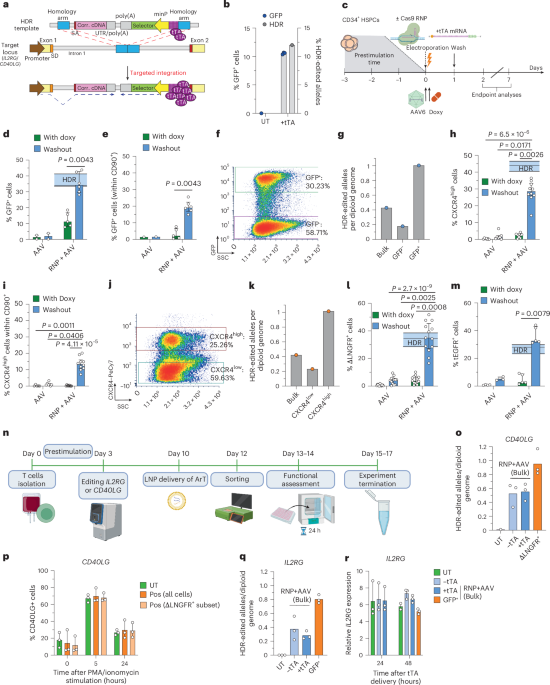
Gene-editing protocols for human HSPCs and T cells were previously described9,39,63 and are shown in Figs. 1c,n and 4a,j and Extended Data Fig. 2d.
HSPCs
After 3 days of stimulation, cells were washed with ten volumes of Dulbecco’s PBS without calcium and magnesium (DPBS) and electroporated using the P3 primary cell 4D-Nucleofector X kit and the Nucleofector 4D device (program EO-100, Lonza; 1 × 10⁵–9 × 10⁵ HSPCs per well; Figs. 1b–m, 2b–g, 3a–k,n–p and 4b–i), or Opti-MEM (Gibco) with MaxCyte GTx (program HSC-3, MaxCyte, 1 × 10⁶–20 × 106 HSPCs per well, OC-25×3 or OC100x2 cuvettes; Figs. 1o–r, 2h–t, 3l and 4k–r). Cells were electroporated with Cas9 RNPs at a final concentration of 1.25–2.5 μM. In some experiments, 0.1 nmol of Alt-R Cas9 electroporation enhancer (Integrated DNA Technologies) was added to the mix. AAV6 transduction was performed at a dose of 2 × 10⁴ vector genome copies (vg) per cell (standard medium) or 5 × 10³ vg per cell (optimized medium; Figs. 2h–t, 3n–p and 4j–r) 15 min after electroporation, unless otherwise specified. When indicated, mRNAs were added to the electroporation mix at the following final concentrations: 150 μg ml−1 tTA, 150 μg ml−1 T3-VPR, 250 μg ml−1 T7-VPR, 150 μg ml−1 GSE56 and 250 μg ml−1 GSE56/E4orf6/7.
For SMArT-3 Cas9 RNP and dCas9–VPR in Extended Data Fig. 5a,b, cells were electroporated with RAG1 RNP, dCas9–VPR mRNA, 72.5 pM each of RAG1 15-nt truncated g2 and g3 or g4 and g5 and GSE56 mRNA, using the Nucleofector 4D device as described above. For the SMArT-3 Cas9–VPR experiments at the AAVS1 locus in OC-25×3 (Fig. 5c–f), cells were electroporated with 38 pM AAVS1 gRNA, Cas9–VPR mRNA, 114 pM AAVS1 truncated g10 (12 nt), 57 pM each of the CXCR4 truncated g116 (15 nt) and g160 (14 nt) and GSE56 mRNA. For IL2RG (Fig. 5g,h), cells were electroporated with Cas9–VPR mRNA, 38 pM IL2RG gRNA and 57 pM each of the IL2RG truncated g2 (15 nt), IL2RG truncated g5 (15 nt) and GSE56 mRNA. For Extended Data Fig. 5f, reagent concentrations were 114 pM for individual tgRNAs or 57 pM each when tgRNAs were combined. Cells were electroporated with the Nucleofector 4D device as described above. AAV6 transduction was performed at a dose of 2 × 10³–2.5 × 10³ vg per cell (optimized medium) 15 min after electroporation. When indicated, mRNAs were added to the electroporation mix at final concentrations of 200 μg ml−1 dCas9–VPR, 200 μg ml−1 Cas9–VPR and 120 μg ml−1 GSE56.
T cells
First, 3 days after stimulation with T cell TransAct 60 μl ml−1 (Miltenyi Biotec), cells were edited at the IL2RG locus using the P3 primary cell 4D-Nucleofector X kit and Nucleofector 4D device with RNPs at a final concentration of 2.5 μM. AAV6 transduction was performed at a dose of 5 × 10⁴ vg per cell 15 min after electroporation.
For Fig. 1n–r, CD4 T cells were processed as above until day 3, stimulated with Transact 10 μl ml−1 and edited as reported previously39. Then, 7 days after editing, 0.5 μg of tTA mRNA was delivered to 3 × 10⁵ T cells by LNPs (T cell kit; 1000701, Cytiva). For LNP preparation, a single reaction of mRNA working solution was prepared by mixing 11 µg of tTA mRNA with 3.52 µl of 10× formulation buffer and filled up to 35.2 µl with sterile water. Quantification of encapsulated mRNA was performed using the Quant-it RiboGreen RNA assay kit (Thermo Fisher Scientific), following the manufacturer’s instructions. Cells were washed 24 h after LNP delivery. For evaluation of CD40LG expression, T cells were stimulated with phorbol 12-myristate 13-acetate (PMA; 10 ng ml−1) and ionomycin (0.5 μg ml−1) as previously described39.
Cell lines
K-562 cells were purchased from the American Type Culture Collection. For Fig. 5b, the H1 K-562 cell clone was electroporated with the 0.5 μg of plasmid expressing gRNA along with 2 μg of Cas9–VPR mRNA using the P3 primary cell 4D-Nucleofector X kit and Nucleofector 4D device with the nucleofection code FF120. For all other experiments, the K-562 cell line or clone H1 was nucleofected with 1.5 μg of the TALE–ArT-expressing plasmid or mRNA or 1.5 μg and 0.5 μg of the plasmids expressing dCas9–ArT and gRNA, respectively.
Flow cytometry
Immunophenotypic analyses were performed on a fluorescence-activated cell sorting (FACS) Canto II (BD Pharmingen). A total of 0.5 × 10⁵–2 × 10⁵ cells from culture or mouse samples were stained for 15 min at 4 °C with antibodies listed in Supplementary Table 3 in a final volume of 100 μl and then washed with DPBS + 2% heat-inactivated FBS. Single stained samples or compensation beads were used as controls. The live/dead fixable dead cell stain kit (Thermo Fisher) or 7-aminoactinomycin D (Sigma Aldrich or Biolegend) was included during sample preparation according to the manufacturers’ instructions.
Cell sorting was performed on a BD FACSAria Fusion (BD Biosciences) equipped with four lasers: blue (488 nm), yellow/green (561 nm), red (640 nm) and violet (405 nm). Cells were sorted with an 85-mm nozzle. Sheath fluid pressure was set at 45 psi. A highly pure sorting modality (four-way purity sorting) was chosen. Sorted cells were collected in 1.5-ml Eppendorf tubes containing 500 μl of DPBS or HSPC medium. Cell sorting in Figs. 1n, 2h–t, 4j–r and 5 and corresponding Extended Data figures were performed on a MACSQuant Tyto Cell Sorter (Miltenyi Biotec) using the MACSQuantify Tyto software and equipped with blue (488 nm), red (640 nm) and violet (405 nm) lasers. Gating strategies for flow cytometry analyses are provided in Supplementary Fig. 2. Data were analyzed with FCS Express 7 Flow or FlowJo 10.
Clonogenic assay
A colony-forming-unit (CFU) cell assay was performed 1 day after editing by plating 800 mPB-derived HSPCs in methylcellulose-based medium (MethoCult H4434, StemCell Technologies) supplemented with 100 IU per ml penicillin and 100 μg ml−1 streptomycin. Then, 2 weeks after plating, CFUs were counted and manually picked.
Quantification of NHEJ, HDR editing efficiency and large deletions
gDNA was isolated with QIAamp DNA micro kit (Qiagen), according to the manufacturers’ instructions. NHEJ frequency was assessed by T7 surveyor assays. The target region was PCR-amplified using the primers listed in Supplementary Table 3. The PCR products were then denaturated and reannealed to allow the formation of heteroduplex DNA, which was subsequently cleaved by T7 endonuclease I (NEB), as previously described63. The digested DNA fragments were quantified using the 4200 TapeStation system (Agilent). NHEJ frequency was calculated as follows:
$$\frac{\sum (\text{edited band intensities})}{\sum (\text{edited band intensities})+\text{parent band intensity}}\times 100$$
For HDR ddPCR analysis, 5–50 ng of gDNA was analyzed using the QX200 or QX600 ddPCR System (Bio-Rad) according to the manufacturer’s instructions. HDR ddPCR primers and probes were designed to span the vector-genome junction (Figs. 2a and 3a)5,9,63. Human TTC5 (Bio-Rad) or GAPDH (Bio-Rad) was used as reference. Large deletions were assessed on HSPC-derived colonies as previously described24. Briefly, DNA from colonies was extracted with the QuickExtract DNA extraction solution (Lucigen) according to manufacturer instructions; 5 μl of the DNA was used for ddPCR assays. The large deletion assays amplify a sequence nearby the gRNA target site but outside homology arms. Single colonies showing amplification of the reference genomic amplicon but not of the large deletion assay were considered as bearing a large deletion. Colonies with an insufficient number of positive droplets were excluded. The deletion frequency was calculated as number of colonies bearing a deletion divided by the total number of colonies analyzed. Primers and probes are listed in Supplementary Table 4.
Long-read sequencing of unamplified genomic DNA
For long-read sequencing, DNA from CFUs was extracted using the Monarch HMW DNA extraction kit for cells and blood (NEB). No additional fragmentation was performed. First, 3–5 μg of DNA was processed with the ligation sequencing kit v14 (Oxford Nanopore) and acquired on a P2 Solo R10 flow cell (Oxford Nanopore) using adaptive sampling enrichment for the target locus. Reads were basecalled with dorado dna_r10.4.1_e8.2_400bps_sup@v5.2.0 for maximum quality, aligned to hg38 with dorado version 0.7 (later updated to 1.1.1) and classified manually. Because of limited software accuracy at the single-base level, WT reads and those containing indels or deletions < 50 bp were grouped together. Deletions > 50 bp were classified as deletions. Nonprecise HDR events were classified as either presumably functional and imprecise (for example, donor trapping) or non-functional (for example, trapping of genomic sequences). Representative alignments are reported in Supplementary Fig. 3. Locus coverage was 54.5–104.5 for AAVS1 and 40–65 for IL2RG (for coverage estimation, reads not covering the entire locus but only a vector–genome junction were counted half). The frequency of false-positive translocations (that is, technical artifacts) was established by performing long-read sequencing on a UT sample.
Long-read sequencing of PCR-amplified DNA
For amplicon sequencing of the target locus, we designed primers binding outside the homology arms (Supplementary Table 5). First, 150–400 ng of DNA was amplified with the LongAmp Taq 2× master mix kit (NEB; thermal protocol in Supplementary Table 5). Subsequently, 2–3 μg of amplified DNA was barcoded and sequenced with the SQK-NBD114.24 kit (Oxford Nanopore) according to the manufacturer’s instructions. Libraries were sequenced on a P2 Solo R10 flow cell (Oxford Nanopore) and basecalled with model dna_r10.4.1_e8.2_400bps_sup@v5.2.0.
FUSiLLi
The FUSiLLi pipeline for data analysis was built upon the RAAVioli pipeline63,75,76. Briefly, the approach of the pipeline is to filter informative reads, reconstruct vector–genome junctions and feature sequences and compare all-versus-all reads for unsupervised clustering. Specific details of the pipelines will be reported in a follow-up methodological paper. The main steps of the pipeline are as follows: (1) filtering of reads mapping onto the target locus, beyond the homology arms. whereby reads are mapped with minimap2 onto a custom human genome, where the sequence of the homology arms has been removed and only those within a set interval from the DNA DSB are retained; (2) quality filtering; (3) Alignment of reads with minimap2 to a custom genome consisting of the donor vector genome and the human genome; (4) downsampling across samples to the same number of reads; (5) processing of the alignments with a custom script to identify integration loci (homology arms, ITRs, promoters, etc.) and vector rearrangements using the CIGAR (concise idiosyncratic gapped alignment report) string, akin to the RAAVioli pipeline; (6) recoding of each read as a synthetic feature chain; and (7) all-versus-all comparison and unsupervised clustering of synthetic feature chains, accounting for potential Nanopore read truncations. Editing events are reported as the abundance of feature chains.
Gene expression analyses
Total RNA was extracted using RNeasy Plus micro kit or RNeasy micro kit (Qiagen), according to the manufacturer’s instructions and DNAse treatment was performed using RNase-free DNAse Set (Qiagen). cDNA was synthesized with SuperScript VILO IV cDNA synthesis kit (Thermo Fisher) with EzDNAse treatment. cDNA was then used for qPCR in a Viia7 real-time PCR thermal cycler using TaqMan gene expression assays (Applied Biosystems) mapping to genes listed in Supplementary Table 4. Data were analyzed with QuantStudio real-time PCR software version 1.1 (Applied Biosystem). Alternatively, 2 ng of cDNA was used for gene expression analysis by ddPCR. ddPCR data were analyzed with QX Manager standard edition 2.0.0. Expression of each target gene was normalized to HPRT and, when indicated, represented as fold changes relative to the UT cells. Gene expression assays are listed in Supplementary Table 4.
ATOs
For preparation of ATO medium, RPMI-1640 medium was supplemented with 4% B-27 supplement (Thermo Fisher), 1% GlutaMAX (Thermo Fisher), 0.2% Primocine (InvivoGen), 30 μM ascorbic acid (Sigma Aldrich), 10 ng ml−1 rhIL-7 and 10 ng ml−1 rhFLT3 (both from Peprotech). For ATO seeding, a 0.4-μm Millicell transwell insert (EMD Millipore) was placed in a six-well plate containing 1.1 ml of ATO medium per well. On day 4 after editing, 1.0 × 10⁵–1.2 × 10⁵ HSPCs were mixed with 2 × 10⁵ MS5-hDLL4, the cell aggregates were seeded onto the transwell insert and the number of ATOs per insert was set to 3. ATOs were cultured in 5% CO2 humidified atmosphere at 37 °C and the medium was changed twice per week by aspirating the medium from around the insert and replacing it with 1 ml of fresh ATO medium. ATOs were isolated, disaggregated and passed through a 50-μm nylon strainer. A previously described staining panel was used11, except for anti-CD8b–PE that was replaced by anti-NGFR–PE (Supplementary Table 3). The TCR repertoire was analyzed by the IOTest Beta mark kit (Beckman Coulter) following the manufacturer’s instructions. Flow cytometry and analyses were performed as described above.
Mice
Experiments and procedures involving animals were performed with the approval of the Animal Care and Use Committee of the San Raffaele Hospital (approval nos. 818, 1206 and 1358) and authorized by the Italian Ministry of Health and local authorities. C57Bl/6 Ly45.1 mice were purchased from Charles River Laboratory, Cd40lg−/− (B6.129S2-Cd40lgtm1Imx/J), NOD.Cg-PrkdcscidIl2rgtm1Wjl/SzJ (NSG) and NOD,B6.PrkdcscidIl2rgtm1Wjl/SzJ KitW41/W41 (NBSGW) female mice (The Jackson Laboratory) were held in specific pathogen-free conditions.
For Cd40lg−/− experiments, donor mice between 6 and 10 weeks of age were killed and BM cells were retrieved from femurs and tibias. HSPCs were purified by Lin− selection using the mouse lineage cell depletion kit (Miltenyi Biotec) according to the manufacturer’s instructions. Cells were then cultured in serum-free StemSpan medium (StemCell Technologies) containing penicillin, streptomycin, glutamine and a combination of mouse cytokines (20 ng ml−1 IL-3, 100 ng ml−1 SCF, 100 ng ml−1 Flt-3L, 50 ng ml−1 TPO; PeproTech), at a concentration of 106 cells per ml. C57BL/6-Ly5.1 and Cd40lg−/− (CD45.2) Lin− cells were cultured for 16 h in the medium described above, mixed at the indicated ratios and transplanted at a total dose of 106 cells per mouse unless otherwise specified into 8-week-old lethally irradiated Cd40lg−/− CD45.2 mice. Blood collection and analysis was performed to monitor donor cell engraftment. Mice were immunized intraperitoneally with 100 μg of TNP-KLH (Lgc Biosearch Technologies) in Imject Alum Adjuvant (1:2 ratio) (Thermo Fisher Scientific). Serum was collected at the indicated time points after immunization. Immunization was boosted as described above and the serum was collected after rechallenge. The concentration of antigen-specific IgGs in mouse sera was determined by ELISA, as previously described9.
For transplantation of mPB CD34+ HSPCs, the outgrowths of 1 × 10⁶–2 × 10⁶ culture-initiating HSPCs were injected intravenously into sublethally irradiated NSG mice (150–180 cGy) or nonirradiated NBSGW mice. Sample size for each experiment was determined by the total number of available treated cells. Mice were randomly distributed to each experimental group. Human CD45+ cell engraftment and the presence of edited cells were monitored by serial blood collection. At the endpoint, the BM and spleen (SPL) were collected for analyses.
Quantifications and statistical analyses
The number of biologically independent samples, animals, colonies or experiments is indicated by dots or n in figures. For some experiments, different HSPC donors were pooled to account for donor-related variability and reach the number of cells needed for the analyses. Data were summarized as the median and 95% CI, median and range or mean ± s.e.m. depending on data distribution. Inferential two-tailed techniques were applied in the presence of adequate sample sizes (n ≥ 5); otherwise, only descriptive statistics are reported. Analyses were performed using GraphPad Prism version 10.6.1. Statistical tests are indicated in the figure legends.
Reporting summary
Further information on research design is available in the Nature Portfolio Reporting Summary linked to this article.