The Parliament of Canada is located in Ottawa, which is famous for being “the town that fun forgot”—a description credited to political satirist Allan Fotheringham’s writings of the 1980s. Fortunately for Ottawa, it had been upgraded to “the city that fun forgot” by the time it made international headlines in 2015 when the hacking of a website for persons seeking extramarital affairs revealed that one in five city residents allegedly had accounts. Ottawa even retained its “city that fun forgot” title in 2023 when there was international news coverage of the proposed nightlife czar, a municipal official charged with making Ottawa more fun in the evenings, though perhaps through means other than encouraging extramarital affairs.
Ottawa’s reputation for being soul-suckingly unfun does not help the impression people might have of Parliament. Nor does it help the impression people might have of those who live and work in Ottawa. When the CBC aired a miniseries about Parliament in 2004, a primary critique was that the actors cast were too attractive and well-dressed: “For accuracy’s sake, this show needs more mustard stains, polyester, and back fat.”
While Ottawa may be boring and frumpy, Canada’s Parliament deserves credit for being interesting and sometimes entertaining. Parliament is so much more than a news clip of Question Period in the House. It’s not just the legislative process and its three readings of a bill. It’s a place of substance, sure, but it is also where wild, wacky, and wonderful things happen.
The grass in front of Centre Block has been described as “Canada’s front lawn,” and it’s no surprise that animals occasionally make an appearance.
Enter the legendary Parliament Hill cats. The early press reporting on them is not what you might expect. In a 1936 article about Parliament’s “rare albino cockroach,” it is written that “no one knows where the cats came from, they just arrived, sometimes alone, sometimes in pairs. The pairs caused the trouble. Lovemaking, unmelodious and raucous, echoed through the dignified halls and their tribe increased.” Yes, listening to cats fornicate was once a Centre Block pastime.
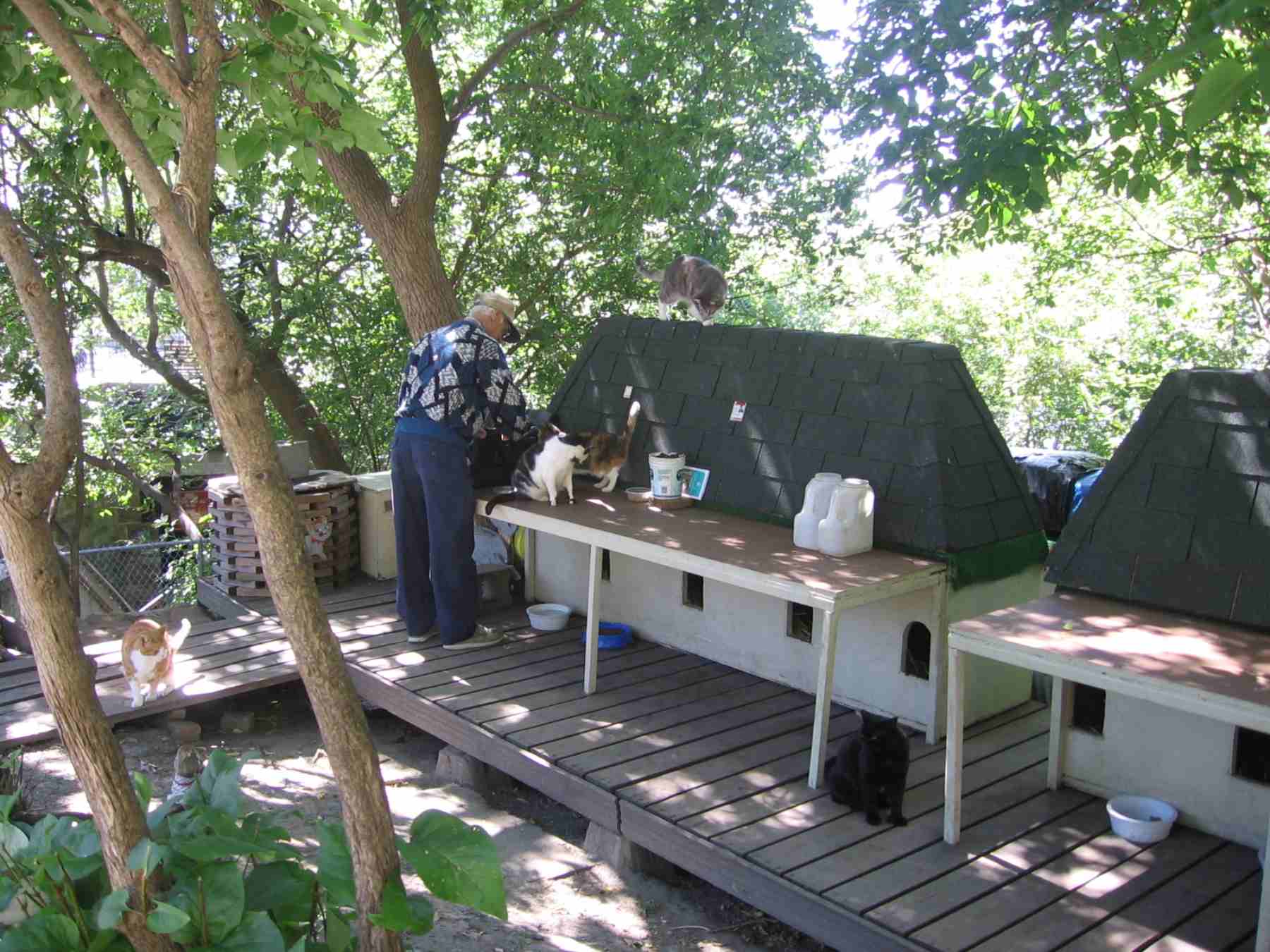
But the bigger cat story on Parliament Hill is that of the cat colony. As explained by the CBC, “Cats were brought to the House of Commons in its early days to catch rodents. But by the ’50s, their hunting skills were no longer needed. Banished to the elements, volunteers started taking care of the mousers, giving them names and building a tiny village on a slope behind Centre Block to protect them. At its height, the sanctuary had more than thirty strays that devoured close to $7,000 worth of cat food every year paid for by donations, not the federal government.”
The cat colony began in the late 1970s. Irene Desormeaux was the “cat lady of Parliament Hill” for eleven years, becoming so well known that “she was even permitted entry to feed her cats when the area was cordoned off . . . for Prime Minister Brian Mulroney’s meeting with US president Ronald Reagan.” Her neighbour was René Chartrand, and—the day before Desormeaux died—he promised to take over her cat duties. His aid was supposed to be temporary, but he ended up tending to the cats for some twenty-one years. He earned the nickname “cat man of Parliament Hill” and was such a fixture on Parliament Hill himself that when he passed away, his obituary began as follows: “When Parliament Hill was locked down after the 9/11 terror attacks, one of the few civilians allowed through the security cordon was René Chartrand. Canada might have been under threat of attack, but Parliament’s cats still needed to be fed.”
The cat colony was a tourist draw, attracting “thousands of visitors each year, from tourists to media to MPs and Hill staff.”
It was so popular that one of the caregivers wrote a letter to the editor asking people to stop abandoning their cats there, explaining that “many people believe their abandoned cats will be well-provided for, but it is rare for the cat colony to accept newcomers. Often, the cats will chase these new arrivals away, as they are viewed as interlopers and a threat to the colony’s stability. . . . Rather than traumatizing your cat by abandoning it on the Hill, please take your animal directly to the humane society.”
Regrettably, the colony was the site of vandalism in 2004, but loving volunteers kept it going for years, even as Chartrand’s health declined. In fact, the donation box was at one point removed because there was too much money being donated. The colony closed in 2013 when “the last Hill cat, a tabby named Bugsy, was captured and adopted.” The colony’s end came as construction increased on Parliament Hill as part of the Long Term Vision and Plan for the Parliamentary Precinct. The last cat of the colony died in 2025, earning a write-up in the New York Times.
The cats and their colony were a hit. The birds? Less so. The news in 2002 was that “the Public Works Department is paying $4,800 a month for a pigeon shooer to prowl Parliament Hill.” To be clear, there is no letter t missing—shooer, not shooter. As explained in an article bearing the alliterative headline “Plan On to Push Pesky Pooping Pigeons from Parliament Hill,” the contract was for “a small team of young men with big sticks to shoo the brazen birds and the occasional misguided gull from nesting and messing on the historic Parliament buildings.”
When interviewed, the pigeon shooer suggested that maybe the cat food at the cat colony was attracting the pigeons. Whether true or not, the pigeons were arguably preferable to some other winged creatures in and around the Hill. In 2015, headlines were made by an aggressive red-winged blackbird dive-bombing from a nest on Parliament Hill and attacking people; footage was played on the national news (and can still be found on YouTube).
Some livestock on the Hill have included cows as part of a dairy farmers’ protest in 2015 and pigs in 1995. Though, to be fair, a farmer brought six pigs to the Hill the same week that 242 plastic pigs appeared on Parliament’s lawn. The pigs were part of a Canadian Taxpayers Federation campaign against changes to MPs’ pension scheme.
The plastic pigs were not the only fake animals to appear on the Hill. Protester Norma Smades was on the Hill for months in 1979 pushing a toy monkey in a baby stroller. The toy monkey’s shirt read “monkey business.” A reporter told her something she didn’t know: she was “the star of the RCMP’s closed-circuit security scanners.” Smades was seeking to draw attention to issues concerning her late husband’s pension.
Canadians have shown no shortage of creativity in what they bring to the Hill for their protests and rallies. However, on at least two occasions, protesters went, shall we say, back to basics.
In July 1992, a rally was held on the Hill in support of the right of women to be bare-breasted. It was felt that the law created a double standard whereby men, but not women, could go shirtless without facing criminal sanction. There were some topless women but also plenty of leering men. As one paper observed, “it wasn’t clear who was there to support them, and who was there to gawk.” The press reported around 6,000 people in attendance, only a handful of whom were topless. Nonetheless, it may have been a success insofar as an MP afterwards said she was looking at introducing legislative changes. At the time of this writing, however, the Criminal Code remains largely unchanged in the relevant provisions; jurisprudence on the point has evolved.
While some of the women of 1992 showed their chests, some of the men in 2002 showed . . . everything. They were protesting the G8 Summit being held in Kananaskis, Alberta. A news report tells us that “at least half a dozen stripped off their rain-soaked gear to dance naked under the shadow of the Peace tower.” The Ottawa Citizen editorial page praised the protesters who “battled the G8 with G-strings,” offering: “We much prefer protests where it’s not your fist you’re shaking.”
Big protests with the potential for violence and damage were feared for the G8 Summit. As a result, the Centennial Flame on Parliament Hill was turned off in anticipation. Thank goodness that happened—one shudders to think of the potential consequences of one wrong move by a naked protester in close proximity to an open flame!

That said, a newspaper report from 1976 references a “June 1975 strip tease by Montreal model Margolene Morin atop the Hill’s centennial flame.” I assumed this was a typo in English and that this was a reference to the woman who would later become the famous Quebecois singer Marjo (born Marjolène Morin). How delighted I was at the thought that perhaps Marjo once performed a striptease on the Hill given that she would later perform there (clothed) as one of the musical acts at the 2010 Canada Day celebrations. Upon further digging, I found that this “Margolene Morin” was better known by the pseudonym Michelle d’Orval. With even more digging, it seems that perhaps the correct spelling of her real first name is Margoline, as this spelling is reported along with the news of possible criminal charges for her striptease stunt. My apologies to the real Marjo.
Michelle d’Orval was posing for photographers atop the Centennial Flame as she was to be the centrefold of a Montreal adult magazine. As the Toronto Star tells it, “For 15 hot, sultry minutes, eight burly Mounties ogled a young brunette draped only in a Canadian flag while they held back a crowd of photographers and tourists on Parliament Hill. Then a breeze wafting over the Confederation Centennial Fountain unfurled the flag and the Mounties moved in.”
The Gazette—under the punny headline “Maple Leaf Striptease Isn’t Forever”—provides a bit more detail: “During the photo session, as she gradually exposed more of her body, d’Orval bantered with the RCMP and even patted one constable on the head. She licked her lips suggestively. The Mounties licked their lips nervously. She shifted the flag and the game was over. Was it part of her stunt to be arrested in a precedent-setting parliamentary first? ‘Yes,’ she said.”
When it became too much for them, the RCMP bundled d’Orval up and hauled her away for questioning. Said the Globe (incredibly!): “Give the unwashed a glimpse of breast today and tomorrow they’ll demand a peek at the Privy Council.”
Speaking of naughty things, once when addressing Canada’s parliamentarians, United Kingdom prime minister Tony Blair offered an apology for his French pronunciation and teased, “There is a story about that which is a bit naughty, so I suppose I had better not tell it to the Canadian Parliament.” A voice responded, “We want to hear it,” and Blair recounted: “Well, okay. I invited Lionel Jospin, the French prime minister, to my constituency one time, and we did a joint press conference live on television. I was asked the question in French whether I was envious of Lionel Jospin’s success and policies. I meant to reply that I was very envious of the magnificent positions he had taken on different policy issues. Instead, I informed the startled French public that I decidedly know Jospin in many different positions.”
That may not actually be the naughtiest thing lost in translation heard in Canada’s Parliament. In 2014, two House of Commons interpreters were having a private conversation that was accidentally broadcast over the French-English feed. What did members hear? According to the press report, it began, “What’s with you? Did you get good news? You get laid last night?”
In short, there are many tales about Parliament, and some are most unparliamentary. But these quirky parliamentary stories deserve to be told, even if the veneer of Parliament might come off a little in the process, to show some of the odd things that sometimes happen in the institutions at the heart of our democracy.
Adapted and excerpted, with permission, from Unparliamentary: Tales from Canada’s Colourful Parliamentary Past by Charlie Feldman, published by the University of Toronto Press, 2026.

Charlie Feldman is the former president of the Canadian Study of Parliament Group with professional experience in Canada’s Senate, House of Commons, and Library of Parliament.