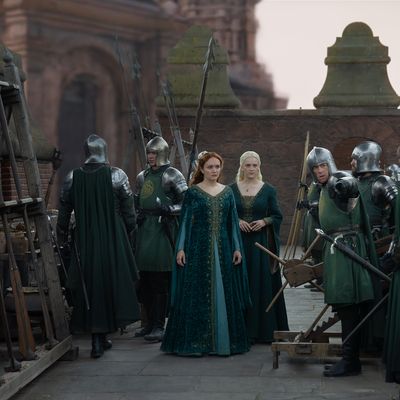

It’s safe to say Rhaenyra’s homecoming is nothing like she imagined.
Photo: Ollie Upton/HBO
Team Black? Team Green? Or just Team Dragon? Join forces and sign up for our subscriber-exclusive newsletter dissecting House of the Dragon season three.
How long since Rhaenyra last felt at home? Dragonstone is the windswept ancestral seat of House Targaryen, but the Black Queen did not grow up playing among its dusky caverns. She was raised on the mainland. King’s Landing is separated from Dragonstone only by a bay, and yet it’s a different world: the bustle of smallfolk and endless summer sun. What must it feel like for Rhaenyra to park her green-eyed dragon in the forecourt of the Red Keep and walk through the palace gates of her own childhood? When she finally ascends the steps to the Iron Throne, is it smaller than she remembers?
By the end of episode two, a new Targaryen will control the Westerosi capital, a depleted House Velaryon will at long last claim its bastard sons, and Otto Hightower, who I forgot was missing, will be recovered and dispatched with. There’s a fleetness to season three that suits George R.R. Martin’s combustible family drama. It’s the age-old tale of rich kids contesting daddy’s last will and testament, but in this particular version, the quibbling brats have dragons. Realistically, it shouldn’t take long for things to go from bad to worse.
When the episode opens, Black’s dragons are patrolling the Gullet, hoping to rescue the Sea Snake from the shoals and incinerating Lohar’s last remaining men as they go. The magnitude of Prince Jacerys’s death was lost in the tumult of battle last week; compared to watching Vermax’s colossal frame be swallowed by the sea, the sight of a sinking boy, puny and fragile, struggled to pack a cinematic punch. Here, though, his passing is given its due. Jace’s face luminous against the black lava rock, the slow progress of his body as it’s carried home to the mother who forbade him to fight. Civil wars have no winners.
A lesser performer might have made a maudlin mess of the funereal scene, but Emma D’Arcy tinges Rhaenyra’s mourning with madness. “What have you done?” she asks, not with the existential hysteria of a mother pleading with the Gods, but to Jace, like her little boy might sit up and say sorry. Her eldest — the repository for her first memories of motherhood, who changed the shape of her days — is gone. It’s paralyzing. Rhaenyra sends Daemon news of the crown prince’s death and her intention to take King’s Landing in the coming days. Then, she goes to bed and gets comfortable.
When the Black Queen’s message arrives in the Riverlands, the king consort, lil’ Oscar Tully, and their new pal Roddy the Ruin are busy reveling, making up ballads dedicated to their own derring-do. (Jason Lannister’s decapitated head and the head of his lion have been impaled on pikes in the background, like a grotesque audience of losers.) Daemon’s been pressing Rhaenyra to be more aggressive, and now, reeling from grief, she’s poised to act. He instructs Tully to split the men. Some will garrison Harrenhal, where Aemond is heading, and the bulk will follow to King’s Landing, setting the cavalry on a collision course with Ormund Hightower.
Before he goes, Daemon bids a quick adieu to Alys, who calls in a favor. In exchange for the help she offered in allying with the Rivermen (back in season two), she wants Harrenhal, a place she loves and understands better than any man ever could. Daemon explains that Rhaenyra can’t grant fiefdoms to spinsters and lady witches, but why not just say, Fun idea, I don’t see why not and deal with Alys’ disappointment later? They could have parted on strained, mediocre terms, but instead she tells him to leave this place and never return — a paradox considering Alys has already told Daemon that he’s destined to die here.
Flying straight from the merry Riverlands into the somber halls of Dragonstone is one hell of a comedown, but Daemon never struggles to access his dark side. Immediately upon his arrival, he finds Hugh Hammer and Ulf the White tooling around the castle when they’re supposed to be ambushing Aemond and Vhagar. On the one hand, they were going to die on that errand; on the other, Daemon might kill them for insubordination. Alas, he has other enemies to poke. After decking Ulf, Daemon’s surprised — or faux surprised, it’s hard to tell when Matt Smith plays Daemon this archly — to learn Mysaria has been elevated from political prisoner to lady-in-waiting. Still, they agree on one point: You can’t trust Alicent Hightower as far as you can throw her.
Finally, Daemon goes to his wife, bereaved, bedlocked, and claiming to have “no stomach” for the business of war. Until he tells Rhaenyra that Vhagar has departed from King’s Landing, that is. We know from the way he’s rallied his troops that Daemon is good in the huddle. By way of a pep talk, he tells his wife, in whispered High Valyrian to make it extra seductive, that in the haunted wood of Harrenhal, he stood before a heart tree and saw visions of the Song of Fire and Ice, of white walkers and dragon eggs. It looked exactly as Viserys told his daughter that it would. Can Rhaenyra muster the courage to be queen to save the world? Suddenly, she’s sitting up.
The remainder of Team Black is scattered. After a disastrous performance at the Battle of the Gullet, Rhaena high-tails it back to the Eyrie, seeking safe haven in her cousin’s mountains. Somehow, she believes she may not have been recognized as the rider of Sheepstealer, though she’s the only unaccounted-for Targaryen with long, icy blonde locs who has also recently spent time in the Vale. Luckily for Rhaena, Lady Jeyne is a pragmatist — and one who feels slighted by Rhaenyra. She will not welcome the disobedient girl in her castle, but she can’t very well stop a wild dragon from roosting. Jeyne believes Sheepstealer offers protection, but surely the Eyrie is the first place Daemon will look when it comes time to avenge Jace’s death. (Perhaps he already suspects his own daughter’s folly, assuming he remembers he has daughters.)
Rhaena is cast out, but the rest of the Velaryon clan are closer than ever. Addam and Seasmoke find Corlys alive and reunite him with Alyn and Baela. They stand together on the shores of Dragonstone, watching smoke billow from their family seat at Driftmark, because I guess it takes a day or so for decades of plunder to burn. With nothing left to offer his progeny but fatherly devotion, the Sea Snake finally bestows it: Addam and Alyn are to carry the Velaryon name, which, whatever its diminished worth, is the only inheritance they ever craved.
Meanwhile, in King’s Landing, Alicent scurries the great halls, desperate to shore up support for her plan to hand Rhaenyra the Red Keep. As she admits to Helaena, she can no longer be sure what Viserys wanted for Westeros, but she knows her children are cruel and unhappy. She cannot change the fates of Aemond and Aegon, but maybe she can save Halaena and Jaehaera. It’s easy enough for her to convince Ser Luthor Largent to turn the Gold Cloaks over to the Blacks; he was always secretly loyal to the family that first elevated him to knighthood.
What constitutes treason is emerging as an early theme of House of the Dragon’s third season. Is it treason for a Gold Cloak to put his Country before the Crown? For a queen mother to privilege her daughter/queen’s wishes above those of the son/king who abdicated in the night? We’d all agree that Jace and Ser Soren betrayed their Queen when they confined her to quarters, but what about the defiance of the dragonseeds? Or Rhaena’s recklessness, which killed the crown prince? Treason is a means — might treason also be a measure of ends?
King’s Landing has been roiling with chaos — the blockade, Aegon’s disappearance — which the mighty presence of Vhagar kept in check until now. But when the Ironrod catches Alicent filling her bags with the Crown’s rubies (treason), he doesn’t just stop her. Because scarcely can a week pass without this woman enduring an assault, he attempts to rape the queen mother (treason, I think). Alicent fights back and is ultimately rescued by Grand Maester Orwyle, who hears her screams. Ser Jasper is arrested, but the atmosphere in the city is lawless. If Rhaenyra is denied entry, the Ironrod won’t be the last to exploit the power vacuum left by the prince regent’s absence.
Finally, unable to stand down the household guard on her own, Alicent confesses her scheme to Helaena, who orders the sentries on the ramparts to hold fire when Rhaenyra flies in on Syrax. Ser Freddryk is conflicted, but ultimately obeys. As Lord Ormund put it last week, “One king is as good as another.”
Ser Simon Strong shares his easy appetite for alliance-hopping. By this point in House of the Dragon, we’ve seen a lot of dragonfire. The more arresting visual is the pause that precedes the exhale — the orange blush deep in Vhagar’s throat, like a glowing tonsil, before he lights up the scant soldiers at Harrenhal. Earlier in the episode, when Daemon and the Rivermen defeated the Lannisters, Ser Simon rewarded them with wine from the cellars. But when Aemond arrives unexpectedly, the castellan wonders if a duel can’t be avoided. Aemond kills the old man anyway, and then kills his sons, though not before being stabbed in the back himself. Unluckily, Alys, freshly alienated by Daemon, arrives just in time to nurse the enemy of her enemy back to health.
As Rhaenyra and Daemon, flanked by Ulf and Hugh, appear over King’s Landing, we get a glimpse of Hugh’s wife, Kat, and Ulf’s old drinking buddies running for cover. It’s a nice nod in the direction of continuity, and a look at the people for whom Lord Ormund’s statement has been most true. The rhythms of the lives of the smallfolk don’t change much with the identity of the person who sits on the Iron Throne — “one king is as good as another.” It’s the wars between the old king and the new that upset their lives.
We also get a glimpse of Alicent and Helaena, who have not fled the city fast enough. But Alicent has upheld the first part of the bargain. The household guard allows Rhaenyra and Daemon to land their dragons within the walls of the Red Keep. As they make for the throne room, they meet some mild resistance, but Daemon would never have been satisfied by a wholly bloodless victory. Plus, Matt Smith sounds cool when he bellows into the reverberant halls: “Who else dares rise against us in our house?” The answer is Ser Rickard and only Ser Rickard. When the Gold Cloaks march into the palace and proclaim their new loyalties, Rickard’s men defy him by laying down their swords, too.
It’s not enough to say you’re the new queen, though. You have to get rid of the old king, the more publicly, the better. It’s not just dangerous to leave a potential (re)usurper at large. It’s bad optics. Rhaenrya will undoubtedly make a better monarch than Daemon, but Daemon understands that the game of thrones is theater. To make up for Aegon’s absence, he proposes the indiscriminate taking of heads, starting with Maester Orwyle. In turn, Orwyle — so eely when confronted with his own death that he might make a formidable Master of Whispers himself — suggests the dungeons could offer more “satisfying” proxies. Daemon descends to retrieve the Ironrod, but comes back up with a shocking gift, left for the returning Blacks by Aegon’s road trip buddy, Lord Larys. (For the record, no one is eelier than Larys.)
When Otto Hightower disappeared in season two, it was unclear who had taken him and to where. As the season wore on, it was unclear if anyone gave a shit that he was missing in the first place. Were search parties sent to the Crownlands and beyond? Seemingly, no one bothered to check the basement. Rhaenyra cannot behead the Usurper, but this man — her father’s hand, who manipulated them all in the name of naked ambition — makes a fitting surrogate. There would be no King Aegon II without Otto.
Rhaenyra’s been practicing her swordsmanship, but still she worries to Daemon that she doesn’t have what it takes — the muscle, the steeliness — to guillotine Otto before her new court. Back in season two, Daemon would have seized this moment to make his own show of strength. But he’s walked among the weirwood now and has seen that the future of Westeros requires his wife. He encourages her. Through spit and tears, Rhaenyra raises her blade above Otto’s neck and draws it down. So what if it takes two tries to sever his head? Maybe death at the hands of your mortal enemy doesn’t need to be quick and painless.
As Rhaenyra finally climbs the steps to the Iron Throne, she trails footprints of Hightower blood behind her. What does she think as she looks out from Viserys’s chair? Is she preoccupied by what she’s already lost — or by how much fighting lies ahead? Because this moment of homecoming is a symbolic victory for the Black Queen. Aemond is not going to back down, and Aegon has already ditched his plan to abdicate. Rhaenyra promised Alicent her freedom, and somehow her stepmother stands before her, her eyes pleading for mercy. She’s not yet Lady of the Seven Kingdoms, but now that she sits on her father’s throne, Rhaenyra will be forced to decide the kind of queen she’ll be.
Meet New York staffers in the comments section to discuss the same burning questions we’re trying to answer in House of the Dragon Club, our subscriber-exclusive newsletter. Sign up here or enter your email below to get the latest editions.
See All