
Inside the politics of The Pitt, a surprise Traitors submission, and an Emmy run for Heather Gay.
Photo-Illustration: Vulture; Photos: Bravo, Euan Cherry/Peacock via Getty Images, Warrick Page/HBO Max
When Emmy-nomination voting opened on June 11, the Emmys’ website posted PDFs for every single Emmy category, outlining every show, performer, and craftsperson eligible to be voted for. It’s an exhaustive series of lists, supremely helpful as a reminder of how much TV has been produced in the last year and where everything is categorized. Within these nearly three dozen documents are a bunch of curious, surprising, and illuminating things about this year’s Emmy hopefuls. It’s just a matter of setting aside the better part of two days to dig them out. Which is what I’m here for. The following are a handful of the most interesting and eye-opening revelations contained in the 2026 Emmys ballots.
One of the biggest questions this Emmy season is how many The Pitt cast members will get acting nominations. Noah Wyle, Katherine LaNasa, and Shawn Hatosy all won trophies last year, but they were the only Pitt cast members who were nominated. With another season under its belt (and no Severance or The White Lotus to gobble up 11 supporting nominations between them), The Pitt is poised to receive a bunch more acting nominations. The nominating ballot lists five Pittsters in Supporting Actor and seven more in Supporting Actress. All seven supporting actresses are series regulars: defending champ LaNasa along with Shabana Azeez, Isa Briones, Taylor Dearden, Fiona Dourif, Supriya Ganesh, and newcomer Sepideh Moafi. On the Supporting Actor side, regulars Patrick Ball and Gerran Howell are joined by recurring performers Hatosy, Charles Baker, and Lucas Iverson.
Conspicuous by their absence are a handful of recurring performers, including Amielynn Abellera, Kristin Villanueva, Jalen Thomas Brooks, and Brandon Mendez Homer, who play nurses Perla, Princess, Mateo, and Donnie, respectively. Laëtitia Hollard played first-day-on-the-job nurse Emma Nolan and was a major presence in the season, even getting attacked by a patient at one point, but she’s absent as well. Particularly curious is Irene Choi, who isn’t on the ballot for her performance as med student Joy Kwon, even though her character was essentially on a parallel track to Iverson as med student James Ogilvie. You could argue that it’s not likely that any of these performers were prominent enough to have a realistic chance at nominations, but it can’t help but feel a little rude to see members of The Pitt family left outside the kudos circle.
So, is The Pitt just overtly disrespecting certain cast members by leaving them off the ballot? Probably not. Performers get onto the Emmys ballot in one of two ways: The show or network submits on their behalf, or they can submit themselves. The fact that every single main cast member is on the ballot suggests that HBO made sure all main cast members were submitted and then allowed recurring performers to submit themselves. A source close to the show confirmed to me that HBO “did not go very much deeper than series regulars.”
Part of this is strategy. With seven series regulars in the Supporting Actress race and two more in Supporting Actor, it doesn’t behoove HBO to load those categories up with recurring players who don’t realistically have a shot at a nomination and would only serve to cannibalize the votes for the actors who do have a shot.
Everybody else in the cast, including recurring cast members who play hospital staff as well as guest-starring patients, were free to submit themselves, which is likely how Charles Baker and Lucas Iverson got there. Baker, who played homeless patient John Digby, is in Supporting Actor rather than Guest Actor because he appeared in 12 of the season’s 15 episodes, and the Emmys require guests to appear in fewer than half of a season’s episodes. The Pitt has in total 11 guest performers on the ballot, including Daytime Emmy winner Brittany Allen, who submitted on her own behalf for playing a dying mother in seven episodes, juuust under the threshold for needing to submit for Supporting Actress (and apparently she was sweating that she’d end up in an eighth).
It’s never happened before, but a reality-competition series might end up as a nominee in the Outstanding Writing for a Variety Series category. In what’s historically been the realm of late-night TV writing teams — Last Week Tonight With John Oliver has won this award every year for the past decade — Peacock’s The Traitors sits as one of 11 series on the ballot.
What exactly is The Traitors doing here? Well, for one thing, nothing’s stopping them. We reached out to TV Academy president Maury McIntyre, who told us that reality-competition programming is fully eligible to submit to the Writing for a Variety Series category. “No petition is needed to qualify for this category,” he said, only that “the individual must have an eligible writing credit.” While the Emmys rules specify that a scripted variety series “is primarily scripted, or loosely scripted improv, and consisting of discrete scenes, satire, musical numbers, monologues, comedy stand-ups, sketches, etc. Scripted Variety may occasionally feature unscripted elements, but the main intent of the series is scripted or performed entertainment.” But the rules for the writing category specifically state that entries “may include variety series, or reality competition programming series.”
And yes, obviously there is writing done for pretty much every reality competition show. Hosts and judges have their scripted patter. Certainly somebody is writing all those runway quips on RuPaul’s Drag Race. So kudos to the folks at Peacock for realizing that whomever wrote Alan Cumming’s “something wicked this way comes” narration and Black Ball theatrics are Emmy-worthy in their own right.
Their competition besides Last Week Tonight includes 2025 nominees The Daily Show and Saturday Night Live, plus sentimental favorite The Late Show With Stephen Colbert; network series Jimmy Kimmel Live, The Tonight Show With Jimmy Fallon, and Late Night With Seth Meyers; panel shows Real Time With Bill Maher and Have I Got News for You; and YouTube’s Hot Ones. Three of those shows are NBC shows — SNL, The Tonight Show, and Late Night — which puts The Traitors in the position of trying to leapfrog three fellow series from under the NBC Universal umbrella.
The Writing for a Variety Series award isn’t episode-specific the way the drama and comedy writing awards are; the ballot doesn’t name the eligible writers, but it would be the show’s entire writing team who’d be nominated.
It’s no longer news that the TV industry has been contracting since the strikes three years ago, and so the total number of TV shows eligible for nominations is down for the third straight year. While the numbers of comedies on the ballot stayed almost level with last year (up very slightly to 71 from 69), dramas dropped from 126 in 2025 to 110 this year, and limited/anthology series are down to 31, from 44 last year. The numbers are more striking if you go back to the peak year of 2022: There are 40 percent fewer comedies this year than the 118 of 2022; dramas are down 36 percent (from 171), and the number of limited/anthology series this year is essentially half of the 61 that were eligible four years ago.
Despite how far the total number of shows have fallen, Emmy rules still dictate that the Outstanding Drama Series and Outstanding Comedy Series categories nominate eight shows apiece. (One out of every nine TV comedies will be Emmy nominated.) The acting categories aren’t so fortunate. Emmy guidelines state that the number of nominees in the acting categories will be proportionate to the number of acting submissions in that category.
20–80 submissions = five nominees
81–160 submissions = six nominees
161–240 submissions = seven nominees
More than 240 submissions = eight nominees
None of the six leading performance categories exceeded 80 submissions. The closest any category came was Lead Actor in a Drama Series, with 78 names. So all six leading categories will be restricted to five nominees each. It’s the second year in a row of five nominees in all leading categories; before last year, that hadn’t happened since the acting categories expanded in 2009.
As for the supporting performers, there were 185 submitted Supporting Comedy Actors, 149 Supporting Comedy Actresses, 228 Supporting Drama Actors, and 222 Supporting Drama Actresses. Once again, the drama categories come close to jumping over the next threshold, but instead all four categories will have seven nominees. With 84 submitted supporting actors in the Limited/Anthology/Movie category, and 66 supporting actresses, those two categories will have six nominees. In short:
Lead Actor in a Drama: 5 nominees
Lead Actress in a Drama: 5 nominees
Supporting Actor in a Drama: 7 nominees
Supporting Actress in a Drama: 7 nominees
Lead Actor in a Comedy: 5 nominees
Lead Actress in a Comedy: 5 nominees
Supporting Actor in a Comedy: 7 nominees
Supporting Actress in a Comedy: 7 nominees
Lead Actor in a Limited/Anthology Series or Movie: 5 nominees
Lead Actress in a Limited/Anthology Series or Movie: 5 nominees
Supporting Actor in a Limited/Anthology Series or Movie: 6 nominees
Supporting Actress in a Limited/Anthology Series or Movie: 6 nominees
Strategy is crucial when it comes to submitting writing and directing contenders for Emmy consideration. Individual writers and directors (or teams of writers and directors) are only able to submit once per series. So when, for example, Lucia Aniello directs six of the ten Hacks episodes in its final season, she’s only able to submit one of them. But on top of that, many series decide to submit only one episode per category to keep from cannibalizing their own vote totals.
This year, the top comedies mostly stuck to submitting one episode per category, while the top dramas went all out with multiple selects. Hacks submitted only its series finale episode (titled “Hacks,” in fact) for Aniello’s directing and Aniello, Paul W. Downs, and Jen Statsky’s writing. Widow’s Bay also went with the streamlined approach, submitting only its season premiere, written by Katie Dippold and directed by Hiro Murai. Michael Patrick King directed every episode of The Comeback, and he and Lisa Kudrow wrote every episode, so they were limited to one episode per category; “Valerie Does It All” (the one where Valerie has to scramble to get a new script after the AI bot goes wonky) is the writing submission, while “Valerie Faces Reality” (the season’s best episode, where Valerie obliterates that twink costume designer and then mourns Mickey) is the directing submission.
The Bear submitted three episodes in writing, including the recently released bonus episode “Gary,” written by Ebon Moss-Bachrach and Jon Bernthal. “Worms,” the Sydney-specific episode, written by Ayo Edebiri and Lionel Boyce and directed by Janicza Bravo was submitted for both writing and directing.
In the drama categories, the two top contenders both submitted big. The Pitt kept it to only two episodes in the writing category: “12:00 P.M.” (written by Valerie Chu), where beloved patient Louie dies and is memorialized, and “1:00 P.M.” (written by Kirsten Pierre-Geyfman and R. Scott Gemmill), where nurses Dana and Emma collect evidence for a rape kit from a sexual-assault victim. Meanwhile, Apple TV’s Pluribus submitted seven of the season’s nine episodes for writing consideration and likely only didn’t submit the other two because writers Vince Gilligan, Alison Tatlock, and Gordon Smith were already submitted for other episodes. (Pluribus appears to have a huge writing staff.) In the directing category, both The Pitt and Pluribus went equally ham, submitting six episodes apiece. The Directing for a Drama Series has nominated multiple episodes from at least one series in ten of the last 11 years (last year, both The Pitt and Severance got double nominations), so loading up in this category doesn’t seem like a bad idea for the front-runners.
In the Limited/Anthology Series categories, the rules can make for an imbalanced competition. If a limited series has the same writer and/or director for the entire run, that writer or director can submit the entire series in toto. Last year, Adolescence won the writing and directing categories after submitting the full series to the ballot. This year, that’s what HBO is doing for Half Man (written by Richard Gadd) and DTF: St. Louis (written and directed by Steven Conrad). By contrast, shows like Beef and Love Story: John F. Kennedy Jr. & Carolyn Bessette feature multiple writers and directors and so needed to decide which episodes to submit.
Beef series creator Lee Sung Jin is a credited writer on every episode (with co-writers), so he can only be submitted for the writing award once. In this case, it was for the season premiere, “All the Things We’re Never Going to Have.” Three Beef episodes are on the ballot for directing: “Oh, the Comfort, the Inexpressible Comfort” (the hospital episode), “Those Blue Remembered Hills” (the one where Oscar Isaac trips on bufo), and “It Will Stay This Way and You Will Obey” (the finale).
Meanwhile, Love Story submitted multiple episodes in both writing and directing. The pilot episode, the wedding episode (“The Wedding,” written by Juli Weiner and directed by Gillian Robespierre), and the one where John and Carolyn have the fight in Battery Park (“Battery Park,” written by Kim Rosenstock and directed by Crystle Roberson Dorsey) were submitted for both writing and directing, while the final two episodes of the series — “Exit Strategy” and “Search and Recovery” — were also submitted for directing. (They were directed by Jesse Peretz and Anthony Hemingway, respectively.)
Widow’s Bay is on the Emmys nomination ballot a grand total of 27 times in 19 categories, but no matter how things shake out for the Apple TV series on nomination day (the Emmys getting Jeff Hiller to co-present the nominations is a good omen) there will be opportunities for some residual Emmys love next year. Since the last three episodes of its first season aired after the eligibility window of May 31, Widow’s Bay will be eligible for episode-specific awards next year for just those three episodes. This includes writing, directing, and guest-acting awards.
This quirk of the Emmys rules has presented itself several times in recent years. At the 2019 Emmys, The Handmaid’s Tale picked up 11 nominations and three wins in categories like writing, directing, cinematography, costumes, music, editing, and guest acting (Bradley Whitford and Cherry Jones swept the drama guest awards) for a season that had half-aired the year before. HBO Max’s The Other Two was nominated in Writing for a Comedy series in 2023 and 2024 for episodes from the same season. So even if Widow’s Bay doesn’t return for its just-announced second season until after next May, Emmys will still be on the table.
It’s relegated to the Creative Arts Emmys, but every year I secretly hope the Emmy telecast producers will realize the gold mine they have in a category full of songs and bump it up to the main show. Last year’s nominees included the Witches Road song from Agatha All Along, the Adam Sandler song from SNL 50, Kristen Wiig’s song from the documentary Will & Harper, and “We Are the Ghor” from Andor. (Somehow these all lost to the MAGA Christmas song from The Boys but whatever.)
This year’s ballot is full of fun options for original songs, including:
• “Cookin’ It Up,” Brina’s clapback song to her rival Jynnysyz on The Fall and Rise of Reggie Dinkins
• “Wish That You Were Me,” Beanie Feldstein’s Sabrina Carpenter sound-alike song from Only Murders in the Building (co-written by American Idol’s David Archuleta)
• “My Room,” Olivia Rodrigo’s song about living in a perfect bedroom in an exhibit on a bug planet from Saturday Night Live
• “The Dead Dance,” a song that Lady Gaga wrote for the second season of Wednesday
• Chris Fleming’s “Haunted House” song from the end of his HBO Max special, Chris Fleming: Live at the Palace.
My soft spot for Idols of yore has me really pulling for the Only Murders song, which really is an uncanny facsimile of “Espresso.” But I’m also a “vote Reggie Dinkins in all categories” activist, so I’m pulling for that one too.
In an television age where genre seems increasingly like a suggestion rather than a hard-and-fast rule, the Emmys are often the lone arbiter of whether a show is essentially a drama or a comedy. This year’s ballot came to some eyebrow-raising conclusions.
All’s Fair, Hulu’s Ryan Murphy–produced lady-lawyer show starring Sarah Paulson, Kim Kardashian, Glenn Close, and a whole bunch of other actresses who deserve better, was declared to be a comedy. This despite the fact that all episodes ranged from 44–59 minutes and was categorized as a legal drama when Murphy and Kardashian’s partnership was first announced.
On the flip side, HBO’s A Knight of the Seven Kingdoms was categorized as a drama, despite 30-ish-minute episodes and creator Ira Parker repeatedly talking about how the show is a comedy.
Seemingly in an effort to make the flailing “superhero TV show” subgenre feel more easily digestible, this year featured several Marvel- and DC-branded shows skirting the line between comedy and drama. Per the Emmys, HBO Max’s John Cena–starring DC series, Peacemaker, is a comedy as are Disney Plus’s Wonder Man and Prime Video’s Spider-Noir. Marvel’s Daredevil: Born Again is considered a drama, however. Also Gen-V, the canceled spinoff of The Boys, has been deemed a comedy while The Boys remains a drama.
This is another Creative Arts category that would be very fun to see on the main telecast. For one thing, it’s wildly star-studded, featuring Oscar winners like George Clooney (for Ken Burns’s Henry David Thoreau), Jodie Foster (Breakdown: 1975), Tom Hanks (World War II With Tom Hanks), Kevin Costner (Kevin Costner’s the West), Julianne Moore (The New Yorker at 100), Octavia Spencer (Lost Women of Alaska), and Kate Winslet (Finding Harmony: A King’s Visit). They make up one-third of the total ballot.
Even better, though, is that all of those A-list names will likely be dwarfed by the titans of this category, like Sir David Attenborough, a nine-time nominee and three-time winner, who this year is on the ballot for three different shows: the BBC America series Kingdom, the National Geographic/Disney Plus film Ocean With David Attenborough, and the Netflix film A Gorilla Story: Told by David Attenborough.
There’s also 2015 winner Peter Coyote, who’s on the ballot for doing what God put him on this earth to do: narrate a Ken Burns documentary series (in this case The American Revolution). Speaking of doing what God put you on the earth to do, Liev Schreiber is on the ballot for narrating a sports documentary, the HBO Max bowling series Born to Bowl.
And if that’s not enough, Werner Herzog is on the ballot for providing his inimitable narration to his own film, the National Geographic/Disney Plus release Ghost Elephants. The Emmys’ producers passing up on even the slightest possibility of a Werner Herzog acceptance speech is sheer lunacy.
While most of these nominations aren’t likely to come to pass, it’s worth noting that Colman Domingo is eligible for directing an episode of The Four Seasons, while Jason Bateman could pick up his third career Emmy nom for directing if he’s nominated for Black Rabbit.
Hustlers director Lorene Scafaria is on the ballot for directing the “Game Night” episode of I Love LA.
In addition to directing the Ayo Edebiri showcase on The Bear, Janicza Bravo is also eligible for directing the “One Wedding and a Sex Pest” episode of Too Much.
Destin Daniel Cretton, director of next’s months Marvel tentpole Spider-Man: Brand New Day, is on the Emmys ballot for directing the “Matinee” episode of Wonder Man. Meanwhile, Toy Story 5 co-director Andrew Stanton is on the Emmy ballot for his Hulu-released anthology film, In the Blink of an Eye.
Horror director Ti West (Pearl; Maxxxine) is on the ballot for directing the Poker Face episode “The Day of the Iguana” but not for directing the Widow’s Bay flashback episode “Our History.”
And in perhaps the least surprising but still funny news of all, Zach Braff is on the Directing for a Comedy Series ballot three times, once each for the Bill Lawrence trifecta Scrubs, Shrinking, and Rooster. Only prolific TV director Jesse Peretz is on the ballot for as many shows, though his are a far more eclectic spread of comedy Nobody Wants This, drama The Summer I Turned Pretty, and limited series Love Story: John F. Kennedy Jr. & Carolyn Bessette.
The TV industry at large may be contracting, but we are in a boom era for famous people hosting travelogues, and that is nowhere more evident than on the Emmys ballot for Outstanding Hosted Nonfiction Series or Special. Everybody wants to be Stanley Tucci, whose Tucci in Italy is one of the 23 shows eligible for nomination in this category. Eva Longoria explored her Francophilia in the CNN series Eva Longoria: Searching for France. Eugene Levy and Phil Rosenthal continue their quests to expand their North American horizons on Apple TV’s The Reluctant Traveler With Eugene Levy and Netflix’s Somebody Feed Phil, respectively. Tiffany Haddish is on the ballot for the Peacock original Tiffany Haddish Goes Off, where she embarks on a girls trip to Africa.
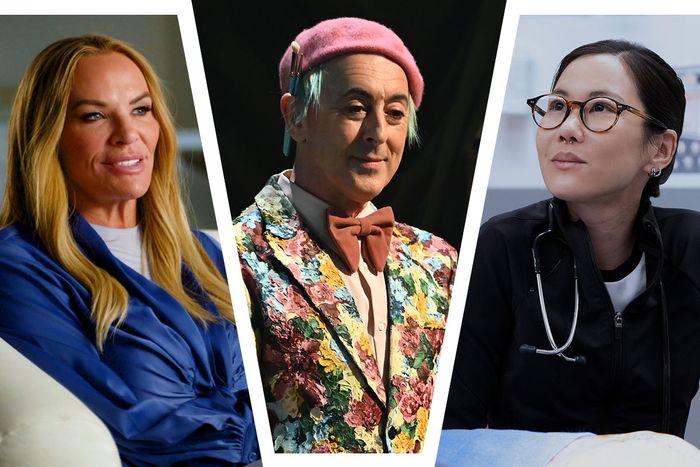
Other fame-os have nonfiction series or specials where they explore less geographically or culinary spaces. Kevin Costner presented the story of the first Christmas in the Hulu special Kevin Costner Presents: The First Christmas. Will Smith traversed the globe for 100 days and did a whole bunch of adventure-quest stuff on the Disney Plus/National Geographic series Pole to Pole With Will Smith. Henry Winkler is on the ballot for reminiscing about the days when asbestos was in everything on the History Channel’s Hazardous History With Henry Winkler. And all eyes in the Bravoverse will be on Real Housewives of Salt Lake City’s Heather Gay to see if her series Surviving Mormonism With Heather Gay will get a nomination.
Last year’s winner, Conan O’Brien Must Go, wasn’t eligible since its third season hasn’t yet materialized.
See All